Showing posts with label Greenhouse Gases. Show all posts

Sunday, May 12, 2013

A Loss of more than just Agriculture

           Robin McKie, a science editor for the Observer, part of the Guardian, recently released an article entitled 'Climate Change 'will make hundred of millions homeless'' informing us of the carbon dioxide levels indicating a rise in temperatures leading to continental agricultural failure.  He tells us that millions will eventually be displaced from their current homes as an effect of global warming and climate change.  Temperatures are likely to rise up at 5 degrees Celsius which will cause a disruption in normal weather patterns including precipitation and drought.  There has been news of carbon dioxide levels reaching an astonishing 400 parts per million (ppm) with rates rising since the 1960's, now at 2.1 ppm/year.  Eventually these rising carbon dioxide emissions will create a feedback loop of rising temperatures to melting ice to loosing coastal lands and so on and so forth.  Changes need to happen and they need to happen soon.

The article can be found here: The Guardian | The Observer


McKie, Robin. " Climate change 'will make hundreds of millions homeless' | Environment | The Observer ." Latest US news, world news, sport and comment from the Guardian | guardiannews.com | The Guardian . N.p., 11 May 2013. Web. 12 May 2013. <http://www.guardian.co.uk/environment/2013/may/12/climate-change-expert-stern-displacement>.

Shrinking the Ozone Hole


           In 2012 the Antarctic Ozone Hole was reported by NASA to be the second smallest size it has been in 20 years.  It had reached it largest size on record Sept. of 2000 at 11.5 million square miles.  It also recorded a minimum value of total ozone that year recorded as the second highest overall level in two decades.  The ozone hole was monitored for the first time by the Suomi National Polar-orbiting Partnership (NPP) satellite using an instrument called the Ozone Mapping Profiler Suite (OMPS).  NOAA along with NASA have a mandate under the Clear Air Act to monitor ozone-depleting gases alone with stratospheric depletion of ozone and does so with ground and satellite measurements.  You can monitor the ozone later above Antarctica with this link!


Human, Katy. "NASA - 2012 Antarctic Ozone Hole Second Smallest in 20 Years ." NASA - Home. N.p., 24 Oct. 2012. Web. 12 May 2013. <http://www.nasa.gov/home/hqnews/2012/oct/HQ_12-371_2012_Ozone_Hole.html>.

An Inconvenient Truth


An Inconvenient Truth was a movie released in 2006 that was a documentary from Al Gore on his campaign about the issue of global warming world wide.  He uses emotional images such as glacier size changes, nuclear bombs, and the destruction of Hurricane Katrina to evoke the viewers.  He also uses many metaphors and analogies throughout the film as well.  Such include flooding causing droughts, the earth breathing, and a frog in boiling water.  There is a bit of fluff throughout the movie as he puts into play random tidbits of his own life throughout the film but there is a good amount of information on this global disruption.

I think that in some cases the movie may be a good teaching tool, but at the same time I think it would be best for a specific crowd.  Maybe for people who already have an interest in the subject it would be a good way to further educate them on the matter.  It may be possible to have other people watch the movie and realize that there is a problem, but it isn’t for certain what would happen because everyone is so different.  


IMDB. "An Inconvenient Truth (2006)."IMDb - Movies, TV and Celebrities. N.p., n.d. Web. 12 May 2013. <http://www.imdb.com/title/tt0497116/>.

Wiki. "An Inconvenient Truth." Wikipedia, the free encyclopedia. N.p., n.d. Web. 12 May 2013. <http://en.wikipedia.org/wiki/An_Inconvenient_Truth>.

Greenhouse Effect


The greenhouse effect is a natural process on Earth that allows our planet to heat up by the sun.  The sun heats the Earth and is responsible for all of the incoming heat for our planet.  From clouds, ice, and snow, some of the heat is reflected back into space.  The clouds will also scatter some of the heat while others will trap it in the sky. Greenhouse gasses are gasses that help take in and release heat from the atmosphere. The more greenhouse gases in the air, such as carbon dioxide from car exhaust, the more difficult it is for heat to escape Earth.  With less heat escaping Earth, the temperature could get higher over time.  The rest of the heat energy that is not reflected or absorbed by clouds or greenhouse gasses is mostly absorbed by the Earth’s surface, while a small portion is reflected back into the atmosphere.
There are two different ways that greenhouse gases are created as well.  Some are natural on Earth and are what allow people to live here.  Things like carbon dioxide and ozone are naturally in our air.  These are good because they heat the planet enough for life.  On the other hand there are human enhanced greenhouse effects that take place.  This is cause by a lot of people using their cars or burning coal, which releases more gases into the air.  This means that there are more greenhouse gases in the atmosphere to trap the heat.  With more heat being trapped in the atmosphere there could be a rise in temperature.

http://www.homahku.com/wp-content/uploads/2012/05/amazing-global-warming-day-greenhouse-effect.jpg

Illustration of the greenhouse effect.  As the sun radiates heat energy to the Earth a series of absorptions and reflections of the energy take place.  The atmosphere along with clouds reflects some energy back into space.  Other energy is absorbed by the earth.  Different activities, such as deforestation, the use of fossil fuels, and the release of greenhouse gases causes for more energy to get trapped in the atmosphere and heat the Earth.

Paralleling Worlds

Marc Davidson wrote a paper in 2005 that compared arguments within the U.S. congress on the previous abolition of slavery and the more recent Kyoto Protocol.  He looked at similarities between the rationals that people have had for slavery and for the emission of greenhouse gases.

"In the case of both slavery and fossil fuel use, there is and was widespread resistance to social
change, unsurprisingly in the light of the cited vested interests at stake. It existed when slavery
was abolished – in the United States sufficient to start a civil war – and it exists today with
respect to cutting consumption of fossil fuels." 
~Marc Davidson, 2008 (pg 70)


Davidson MD. Parallels in reactionary argumentation in the US congressional debates on the abolition of slavery and the Kyoto Protocol. Climatic Change 2008, 86:6782. <http://www.peakoil.nl/wp-content/uploads/2008/01/climagechangeuva.pdf>.

Montreal Protocol vs Kyoto Protocol


            The Montreal Protocol, which was originally established in 1987, was created as a result of the finding of the ozone hole over Antarctica by Rowland and Molina.  They discovered that chlorofluorocarbons (CFCs) were the culprit of the ozone depletion.  The Montreal Protocol was to end the production of substances that deplete ozone, which included the phasing out of CFCs.  In 1990 almost all developed and developing countries came together to join the global treaty of the Montreal Protocol, known formally as the London Amendment to the Montreal Protocol.
This treaty has been very effective especially due to the fact that it has instated a ten year phase out of CFCs by developing countries, made possible through the Multilateral Fund by the developed countries with insufficient funds for transitions.  The Montreal Protocol is also trying to phase out and curb more chemicals that are depleting the ozone layer of our atmosphere.  Due to all of these enforcements of the Montreal Protocol, and the fact that it was agreed to by so many countries around the world, by 2009 CFC emissions were almost zero.  CFCs and HFCs, though they deplete the ozone, are also heat trapping pollutants.  The phasing out of these chemicals has led to a greater slowing of climate change.
On the other hand we have the Kyoto Protocol.  While the Montreal Protocol was established to phase out substances that deplete ozone, the Kyoto Protocol was set in place to reduce the emissions of greenhouse gases, with the exception to ozone depleting substances.  The Kyoto Protocol, established later than the Montreal Protocol, calls for the global reduction of carbon dioxide (CO­2) emissions, which has been heightened greatly by car exhaust throughout the years.  The reduction of CO2 has been significantly smaller per year in comparison to how quickly CFCs were phased out.  There have been more controversies between countries, developed and developing, that has slowed the reduction of greenhouse gases.

Solomon, Susan and Chanin, Marie-Lise. 2011. The Antarctic Ozone Hole: A Unique Example of the Science and Policy Interface. Science Diplomacy. 189-195.
Doniger, David. "The world's governments saved the ozone layer. They can save the climate too. | David Doniger - China Dialogue ." China Dialogue - China and the world discuss the Environment . N.p., 11 June 2012. Web. 10 Feb. 2013. <http://www.chinadialogue.net/article/show/single/en/5295-The-world-s-governments-saved-the-ozone-layer-They-can-save-the-climate-too->.

Tuesday, May 7, 2013

Shade for Change

        Plants have been seen to help slow climate change.  According to Nature Geoscience they are doing this through temperatures rising causing them to emit
gases that lead to the formation of sunshade of clouds over the planet.  This 'sun-dimming' effect is said to possibly offset about one percent of worldwide warming and up to thirty percent locally.  It has also helped to provide more evidence in the importance of forest protection.
        There were eleven sites around the world that were observed to show the tiny particles emitted from plants.  The focus was in Europe, North America, Russia, and southern Africa.  Forests are effected by warming by means of invasive species or pests kept in check by the cold as well as wildfires.


Source: http://weather.yahoo.com/plants-slow-climate-change-forming-cloud-sunshade-study-184108780.html
Nature Geoscience Studyhttp://www.nature.com/ngeo/journal/vaop/ncurrent/full/ngeo1800.html

Doyle, Alister. "Plants slow climate change by forming cloud sunshade - study - Yahoo! Weather." Yahoo! Weather - Weather Forecasts | Maps | News. N.p., 28 Apr. 2013. Web. 7 May 2013. <http://weather.yahoo.com/plants-slow-climate-change-forming-cloud-sunshade-study-184108780.html>.

Cut the Soot

According to a newly publish research in Nature Climate Change, a part of Scientific American, cleaning up soot, atmospheric black carbon, along with other air pollution could relieve breathing problems such as asthma but also slow the rising of sea levels.  Although it has been established that cutting out there greenhouse gases, though they do not stay in the atmosphere very long, could slow climate change overall.  The new study shows that it could also significantly slow the rate of rising sea levels.  It could also prevent about a degree Celsius of additional warming also lessening the melting of sheet ice and warming of ocean waters.

Orig Source: http://news.yahoo.com/cut-soot-stave-off-sea-level-rise-170108651.html
Scientific American Article: http://www.scientificamerican.com/article.cfm?id=unhealthy-soot-could-promote-global-warming&WT.mc_id=SA_syn_Yahoo
Podcast Link: http://podcast.sciam.com/earth/sa_e_podcast_130414.mp3?WT.mc_id=SA_syn_Yahoo


Biello, David. "Cut Soot to Stave Off Sea Level Rise - Yahoo! News." Yahoo! News - Latest News & Headlines. N.p., 14 Apr. 2013. Web. 7 May 2013. <http://news.yahoo.com/cut-soot-stave-off-sea-level-rise-170108651.html>.

Your Carbon Footprint

The Nature Conservancy has a 'calculator' that allows you to calculate your carbon footprint, or impact on our climate.  It estimates the amount of carbon dioxide and other greenhouse gases that you release, by the ton, into the atmosphere each year.  You can also see how making changes in your actions and daily living can change your carbon footprint

Find you what your carbon footprint is here!

Friday, April 26, 2013

Radiative Forcing


     Radiative forcing (RF) describes the difference between the energy that is gained by Earth and then later lost to space.  The IPCC uses radiative forcing with assessments, “to denote an externally imposed perturbation in the radiative energy budget of Earth’s climate system, which may lead to changes in climate” (Braun, 2013).  Greenhouse gas concentration can change and cause a disturbance in the radiative forcings that are calculated.  It is used to assess and compare natural and human related drivers of climate change.  It ranks and quantifies the different influences of climate change but doesn’t represent overall climate responses (IPCC, 2007).
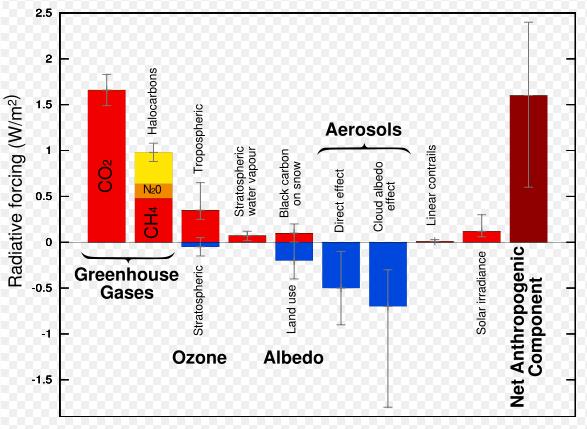
     Radiative forcing can be related to the greenhouse effect as well, both natural and human enhanced.  The imgage belshows a number of radiative forcing drivers, the first two bars, both red, are greenhouse gases, mainly driven by human forces.  Both of these have a large radiative forcing affects.  CO2 emissions cause an increase of RF.  This is due to the fact that carbon dioxide influences the amount of heat that is captured within the atmosphere.  The more heat that is captured due to that specific greenhouse gas, which is influenced by human activities such as driving cars, the higher the radiative forcing bar for that driver.  The third bar that is shown depicts ozone RF, depending on the good or bad ozone there is either a negative or positive RF, which can also be affected by human activities.  


A simple graph showing the components of radiative forcing.  Bars in red show where heat is added while bars in blue show cooling influences.  Heating affects have positive values, while cooling affects have negative values.


Braun, Carsten. 2013. The Concept of Radiative Forcing. Handout.

IPCC. 2007. "2.2 Concept of Radiative Forcing - AR4 WGI Chapter 2: Changes in Atmospheric Constituents and in Radiative Forcing." IPCC - Intergovernmental Panel on Climate Change. N.p., n.d. Web. 22 Feb. 2013. <http://www.ipcc.ch/publications_and_data/ar4/wg1/en/ch2s2-2.html>.