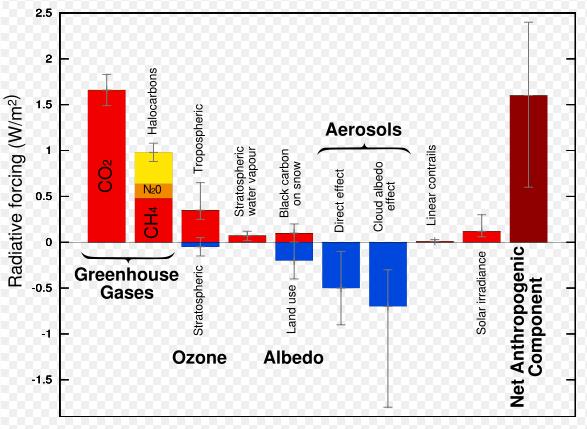
The ozone and climate change are
connected to one another here on Earth.
There are two different types of ozone, the good ozone and the bad ozone.
The good ozone, located in the
stratosphere, creates a sort of shield that protects us from the harmful UV
rays that enter Earth’s atmosphere. The
UV radiation, instead of penetrating down to Earth, is converted into heat
through a molecular reaction of ozone being split apart, but is continually
re-joined with other oxygen molecules, thus forming an ‘ozone-oxygen
cycle’. Human-made compounds such as
chlorofluorocarbons (CFCs) that are added to the atmosphere cause an even
greater breakup of ozone and allow more UV radiation to get down to earth (The
Good, the Bad and the Ozone, 2013).
Bad ozone can be found in the
troposphere, which is where life on Earth is found. Ozone in the stratosphere can cause lung
damage to humans. One of the biggest
contributors to harmful emissions in our breathing air is car exhaust (The
Good, the Bad and the Ozone, 2013). Bad
ozone can also damage crops and other vegetation that cycle carbon dioxide in
our air (EPA).
Back in 1974 it was discovered that CFCs were
in the stratosphere destroying ozone molecules.
A thinning of the ozone layer above Antarctica caused an urgency to stop
production of CFCs and led to the creation of the Montreal Protocol, phasing out CFC use and stopping the hole from becoming larger (Doniger,
2012). Solomon and Chanin (2011) talk
about how CFCs along with other greenhouse gases deplete ozone, but also
contribute to climate change. With more
ultraviolet light able to reach Earth’s surface there can be damage to plants
and animals DNA. Overall, with the ozone
thinning and more heat energy becoming trapped in the atmosphere of the Earth
an overall warming affect is likely to happen (Solomon, 2011).
Doniger,
David. "The world's governments saved the ozone layer. They can save the
climate too. | David Doniger - China Dialogue ." China Dialogue - China and the
world discuss the Environment .
N.p., 11 June 2012. Web. 10 Feb. 2013. <http://www.chinadialogue.net/article/show/single/en/5295-The-world-s-governments-saved-the-ozone-layer-They-can-save-the-climate-too->.
EPA. "Ozone -
Good Up High Bad Nearby | Air Quality Planning & Standards | Air &
Radiation | US EPA." US Environmental Protection Agency. N.p., n.d.
Web. 21 Feb. 2013. <http://www.epa.gov/oaqps001/gooduphigh/>.
Solomon, Susan and
Chanin, Marie-Lise. 2011. The Antarctic Ozone Hole: A Unique Example of the Science
and Policy Interface. Science Diplomacy. 189-195.
“The Good, the Bad
and the Ozone”. Handout. 2013.
<http://earthsobservatory.nasa.gov/Features/Ozone/Ozone.php>. and
<http:http://www.nasa.gov/missions/earth/f-ozone.html>.